The official desk
Is JavaScript the same as Java?
The official MDN glossary article titled “JavaScript” answers this directly. The table below sets the two languages side by side, with each fact tied to its source.
The official MDN glossary is blunt: JavaScript should not be confused with the Java programming language. This desk keeps that answer, and the other official wording around it, in the document it came from.
Java, or JavaScript?
The official MDN glossary article titled “JavaScript” says, with the words “should not” emphasised on the page: “JavaScript should not be confused with the Java programming language. Although “Java” and “JavaScript” are trademarks (or registered trademarks) of Oracle in the U.S. and other countries, the two programming languages are significantly different in their syntax, semantics, and use cases.” [source]
For a fuller side-by-side look at typing, where the code runs, and how it is compiled or interpreted, see the table on this page, or take the free fact sheet.
Where is it used most often?
The same official glossary opens: “JavaScript (or “JS”) is a programming language used most often for dynamic client-side scripts on webpages, but it is also often used on the server-side, using a runtime such as Node.js, Deno, and Bun.” [source]
MDN’s JavaScript landing page, a separate article, also names non-browser environments such as Node.js, Apache CouchDB and Adobe Acrobat. [source]
The third layer of the cake
A different MDN page — the Learn web development article “What is JavaScript?” — says: “It is the third layer of the layer cake of standard web technologies, two of which (HTML and CSS) we have covered in much more detail in other parts of the Learning Area.” [source]
On the same page, JavaScript is introduced as “a scripting or programming language that allows you to implement complex features on web pages,” and later as “a scripting language that enables you to create dynamically updating content, control multimedia, animate images, and pretty much everything else. (Okay, not everything, but it is amazing what you can achieve with a few lines of JavaScript code.)” [source]
The same page then gives each layer a short official job: HTML for structure and meaning, CSS for style, and JavaScript for dynamically updating content, multimedia and animation. [source]
Interpreted, or compiled in time?
The same Learn article says: “JavaScript is a lightweight interpreted programming language.” It then says the browser “receives the JavaScript code in its original text form and runs the script from that.” [source]
It continues: “From a technical standpoint, most modern JavaScript interpreters actually use a technique called just-in-time compiling to improve performance; the JavaScript source code gets compiled into a faster, binary format while the script is being used, so that it can be run as quickly as possible. However, JavaScript is still considered an interpreted language, since the compilation is handled at run time, rather than ahead of time.” [source]
MDN’s JavaScript landing page puts it in one official sentence: “JavaScript (JS) is a lightweight interpreted (or just-in-time compiled) programming language with first-class functions.” [source]
What is ECMAScript?
The official glossary’s short history says that in November 1996, “Netscape began working with Ecma International to make JavaScript an industry standard.” It then says: “Since then, the standardized JavaScript is called ECMAScript and specified under ECMA-262. The standard is constantly updated and implemented (a living standard).” [source]
MDN’s JavaScript landing page also names both standards: “The standards for JavaScript are the ECMAScript Language Specification (ECMA-262) and the ECMAScript Internationalization API specification (ECMA-402).” [source]
A photograph is not the standard
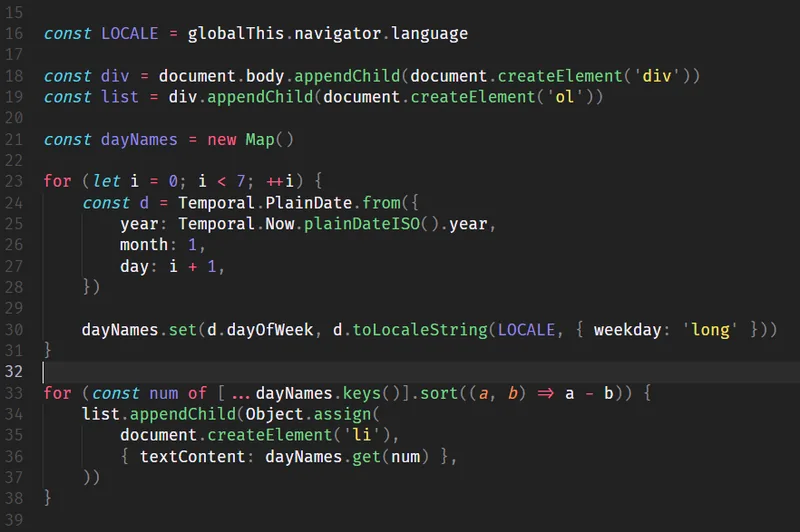
The photographs show someone typing, a monitor full of source, a contributed JavaScript example that lists weekday names, and a laptop running Ruby on Rails — the visible lines mention “The Rails environment is not loaded.” Each caption gives the photographer and the date.
Java and JavaScript, side by side
Each cell stays with the official document it comes from. A printable version is in the free downloads.
| Java | JavaScript | |
|---|---|---|
| What it is | Oracle describes Java technology as both a programming language and a platform. [source] | MDN describes JavaScript as a scripting or programming language that lets you implement complex features on web pages. [source] |
| How the code is run | Source files ending .java are compiled by javac into .class files of bytecodes, the machine language of the Java Virtual Machine. [source] | MDN calls JavaScript a lightweight interpreted programming language. Most modern interpreters also use just-in-time compiling at run time, and it is still considered interpreted. [source] |
| Typing | MDN’s Java glossary: Java is statically typed. [source] | MDN: JavaScript is a “dynamically typed language”, which means you do not need to specify what data type a variable will contain. [source] |
The official glossary sentence
MDN’s glossary says, with “should not” emphasised on the page: “JavaScript should not be confused with the Java programming language. Although “Java” and “JavaScript” are trademarks (or registered trademarks) of Oracle in the U.S. and other countries, the two programming languages are significantly different in their syntax, semantics, and use cases.” [source]
The same article opens by saying JavaScript is “used most often for dynamic client-side scripts on webpages, but it is also often used on the server-side, using a runtime such as Node.js, Deno, and Bun.” [source]
Those are glossary sentences, checked on 17 November 2026. MDN also notes that “Java” and “JavaScript” are trademarks (or registered trademarks) of Oracle in the U.S. and other countries.